OBC System Specifications
This section outlines the system specifications of the SC-OBC Module A1.
The SC-OBC Module A1 is composed of an FPGA, functioning as the main processor on the board, and a TRCH, which manages the system and operates in coordination with the FPGA. Users can customize the system freely by modifying both the FPGA logic and the TRCH program.
Power-on Operation
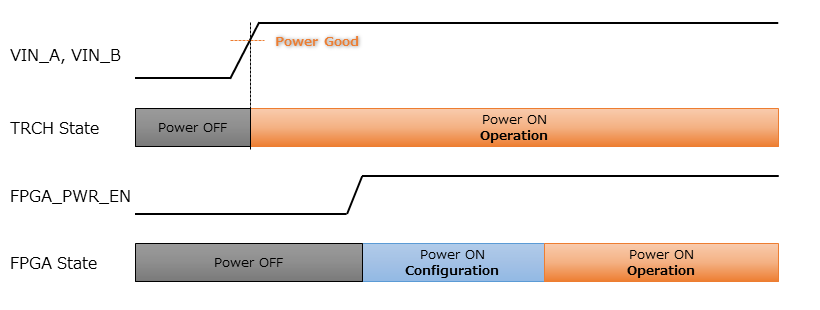
When power is applied to the OBC, the TRCH initializes first.
The TRCH monitors power status and temperature using sensors on the OBC board. If the conditions for FPGA operation are met, it sets FPGA_PWR_EN to HIGH to enable power to the FPGA.
When the FPGA is powered on, the TRCH uses the TRCH_CFG_MEM_SEL signal to select the memory for FPGA configuration. After power is applied, the FPGA reads data from the configuration memory selected by the TRCH and carries out its configuration.
FPGA Status Monitoring via TRCH
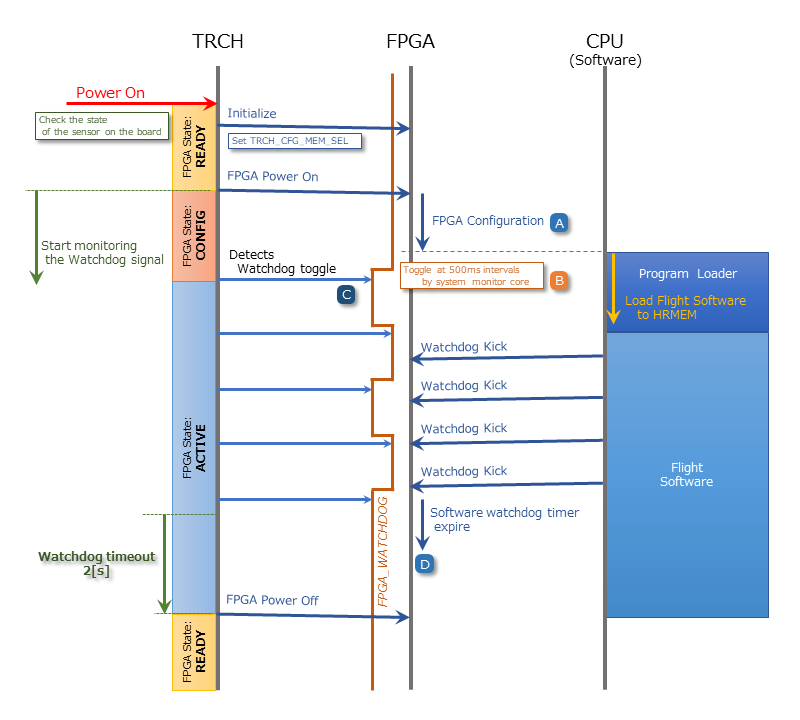
TRCH monitors the watchdog signal (FPGA_WATCHDOG) from the FPGA to detect issues with FPGA configuration or software operation.
When the TRCH powers up the FPGA, configuration begins immediately [A]. Once configuration is complete, the Watchdog circuit within the System Monitor implemented in the FPGA begins toggling the FPGA_WATCHDOG signal connected to the TRCH, independent of software operation [B]. The TRCH verifies that the OBC’s FPGA system is functioning correctly by checking that the FPGA_WATCHDOG signal toggles at regular intervals [C]. The System Monitor inside the FPGA detects that the Software Watchdog Timer has expired if the software fails to reset (kick) the timer within a set period (initially 128 seconds). When this happens, it stops toggling the FPGA_WATCHDOG signal [D].
System Reboot
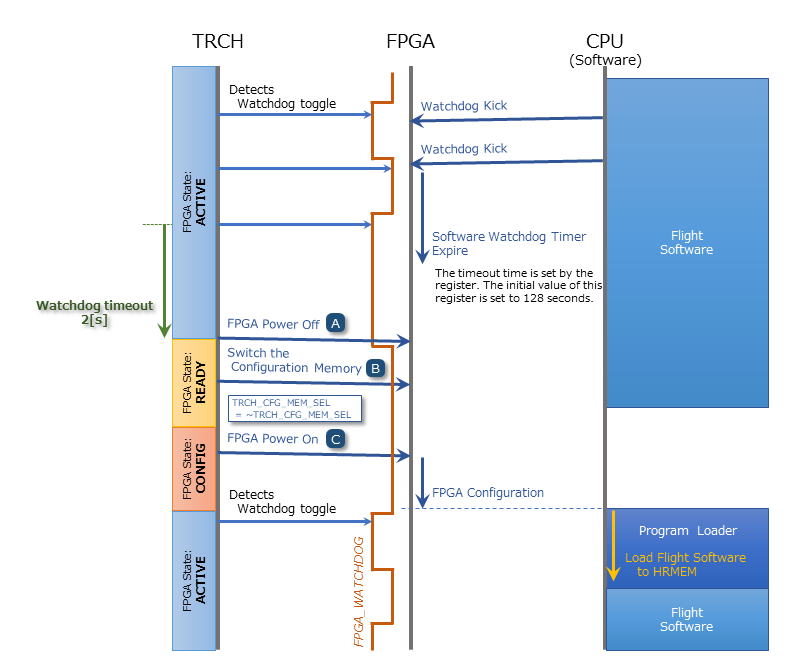
TRCH monitors the Watchdog and Power Cycle Request signals from the FPGA, then initiates the FPGA system power cycle when necessary.
If the FPGA software fails to trigger the Software Watchdog Timer within a specified time due to a problem in the FPGA system, the FPGA_WATCHDOG signal stops toggling after a set period. When TRCH detects that the FPGA_WATCHDOG signal has stopped, it switches off the FPGA power [A].
Before turning the FPGA power back on, the TRCH changes the configuration memory used by the FPGA [B]. This feature enables the FPGA to boot using data from a different configuration memory upon restart. After the configuration memory is switched, the FPGA is powered on again to complete the power cycle [C].
Changes to configuration memory occur both when a fault is detected by the watchdog and when the system is restarted in response to a power cycle request signal from the FPGA. When performing On the Fly rewriting of the configuration memory, if the new data causes a startup failure, the system will automatically restore the original configuration memory by rewriting it for the next startup and issuing a Power Cycle Request.